Search
RSS

Blog

Drip Irrigation

Drip Irrigaiton Is?

Many people have heard of Drip Irrigation, but not everyone knows what it means, where it came from, or how easy it is to implement into your landscapes and gardens. I wanted to write a quick bit about it and share how awesome this method of irrigation can be for your plants.

What is Drip Irrigation?

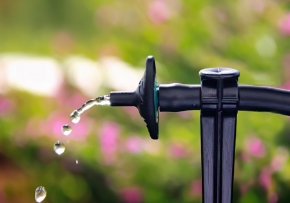
Drip irrigation is an irrigation method that saves water and fertilizer by allowing water to drip slowly to the roots of plants, either onto the soil surface or directly onto the root zone,  Basically, it means that you can control where the water goes - being extremely efficient, effective and environmentally cautious in your plant development. 

Where did it come from?

Drip methods of watering plants where water was scarce have been around for centuries - from ancient times where clay pots were filled with water and allowed to seep into the soil to modern methods that involve poly and vinyl tubing and pressure compensated drippers for a specific flow rate for plants.  The more modern version of drip was developed after World War II, and it was used in arid climates to grow crops.  That method of drip irrigation is very similar to what is used today. With technology leading the way in water conservation, Drip Irrigation is improving constantly, allowing for more water saving and better irrigation of plants then ever.  Electronic water timers and soil moisture sensors can be added to drip systems to make them extremely effective at using water with little or no waste, making Drip Irrigation the most environmentally friendly way to irrigate, outside of natural rain storms.

Installing Drip Irrigation?

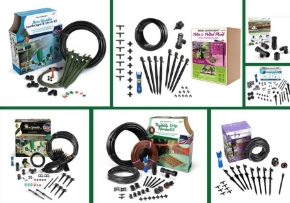
When most people think of installing irrigation, pictures of long hot hours in the sun, digging ditches, laying pipes in the ground, and using tools to cut, manipulate and arrange them, come to mind. All of that is how underground irrigation is installed. Installing drip irrigation is actually really easy by comparison. For home garden and landscape use, many times all that is required is a faucet hook-up somewhere near where the irrigation is to be laid.  This makes installation really fast and efficient for homeowners to set up.  The most simple of Mister Landscaper's Drip Irrigation Kits is set up by attaching it to an outdoor faucet like a hose and running a line of poly to the location where the irrigation is needed.  The only tool really needed is a pair of scissors, and maybe a small hammer if you have hard ground. 

If a homeowner has underground irrigation, it is even easier to install Drip or Micro Irrigation.  For instance, one can easily attach adapters to PVC pipes for existing irrigation and then run lines to the areas where they would like to have drip.  Most set up of Drip or Micro Irrigation can take less then an hour to do and can save over 50% of the water used in traditional irrigation methods.

So, if you want to save time, save money, water your plants the best way possible, and most importantly save water for generations to come, Drip Irrigation and Micro Irrigation is the way to go.

Does Mister Landcaper have the best Drip Irrigation on the planet, Well, we think we do. 

Have an awesome day!

 

Water, Water, Everywhere

Does conservation matter when resources are plentiful?
 
I have had a chance to be on Twitter recently in a discussion about irrigation and conservation. It focused on parts of the U.S. that don't generally have water shortages and why people would pay more to install low-flow irrigation when they had plentiful cheap water for their lawns and landscapes. My answer is the same. Rain patterns change all the time, prices go up on things like water and electricity, and the more populations grow the scarcer the resources will be to support them. In other words, it is better to conserve now and establish positive habits than wait until it becomes an emergency.
 
What are some ways that communities can encourage people to conserve water in a place where it seems like it is everywhere, accessible and cheap to use?
 
Mister Landscaper wants to know. What are your thoughts?
A Guide To Gallonage


Adjustable Drippers and Adjustable Dripper Stakes are extremely versatile. They can easily be dialed from a one gallon-per-hour drip up to a ten gallon-per-hour eight-stream spray. Whether watering potted plants or irrigating a flower bed, you’re never more than a couple “clicks” from the ideal gallonage.

Follow this chart to accurately set water usage with our Adjustable Drippers and Adjustable Dripper Stakes.

To begin, make sure the adjustable head is completely closed by turning it all the way to the right. Now, the appropriate gallonage can be set by counting “clicks” as you rotate.

Note: If the adjustable head is rotated to the left beyond what is recommended, it can come off during use. Adjustable heads are NOT available as spare parts.

Mister Landscaper Tips: Hot Water


Here's an oldie but a goodie.

Let's face it. Sometimes pushing 1/4" Fittings into the ends of 1/4" Vinyl Tubing is not something one would say is particularly a snap. Actually, it's not a snap at all. It's more of a sliding motion, really. But I digress.

The fact is, most of us would rather work a little smarter than harder. Well, here's your chance.

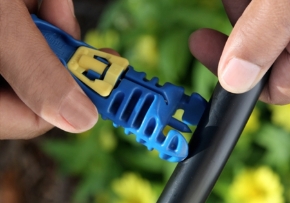
To make inserting any 1/4" Fitting into 1/4" Vinyl Tubing as easy as possible, start by soaking the end of the tubing in hot water.

Before beginning your project, fill a mug with water, then microwave it on high for about a minute. (Amount of time depends on the microwave). Next, cut your Vinyl Tubing to length. Soak the end of the tubing in the hot water for about thirty seconds. Now, simply slide the 1/4" Fitting into the end of the 1/4" Vinyl Tubing. The hot water will have softened the vinyl to the degree that the fitting just slips in. Reheat the water as necessary.

It's a simple tip. But if you have to install a large number of 1/4" Fittings, it may just save your fingers.

Happy irrigating!

Squirrels Need Water, Too!


Ever have one of these in your yard? Chances are you have. They're everywhere. But, honestly, who doesn't love having these small, fluffy critters darting around the backyard? They're cute, right?

Well, perhaps if they're chewing through your Mister Landscaper tubing, they're not so cute. And this is a problem for some.

We've discovered that, on occasion, squirrels will chew through the Mister Landscaper tubing to get to the water. They're thirsty.

The easiest solution is to set out water pans or install a birdbath. As with most things, squirrels will follow the path of least resistance. If water is readily available, they won't bother to chew through your tubing to get it.

However, if squirrels are just not your thing, and you'd rather them be gone altogether, there are alternatives. If you search the internet, you will find everything from homemade pepper concoctions to powdered fox urine. Personally, I like birdbaths. But to each their own.

Happy irrigating!

Memorial Day 2011: Remember Them

At Mister Landscaper, we honor and remember those who have paid the ultimate price for our freedoms.


In Flanders Fields

by John McCrae


In Flanders fields the poppies grow

Between the crosses, row on row, 

That mark our place, and in the sky, 

The larks, still bravely singing, fly, 

Scarce heard amid the guns below. 


We are the dead; short days ago

We lived, felt dawn, saw sunset glow, 

Loved and were loved, and now we lie

In Flanders fields. 


Take up our quarrel with the foe! 

To you from failing hands we throw

The torch; be yours to hold it high! 

If ye break faith with us who die

We shall not sleep, though poppies grow

In Flanders fields.


Be thankful. Be safe. And have a wonderful Memorial Day weekend.


Getting The Most From Your Patio Kit


With each Patio Kit, there are a total of eight Dripper Stakes. And each Dripper Stake can be adjusted to output from zero to ten gallons of water per hour.

There is, however, one thing you should keep in mind when installing a Mister Landscaper Patio Kit - especially if you want to get the most from it.

If you plan on, at any point, simultaneously running all eight Dripper Stakes wide open (10 GPH), it is imperative that you DO NOT run them in a single line. Instead, you must first use one of the included 1/4" Tees and split the system so that it runs in two directions. By doing this, you make sure each stake is receiving the correct amount of water pressure. For reference, you can simultaneously run up to six stakes wide open.

However, if you plan to vary the flow rates between Stakes, then it is okay to run all eight in a single line.

Alternatively, by expanding the system and using Mister Landscaper 1/2" Poly Tubing as the main line, you can increase the number of Stakes to more than 30.

To do this, install a 25 PSI Pressure Regulator and a Poly Faucet Fitting. Then connect and run the 1/2" Poly Tubing around your patio or deck area. Finally, run a single line of 1/4" Vinyl to each Stake. That's it.

Now you know how to get the most from your Patio Kit.

Happy irrigating!

Mister Landscaper Tips: Cooking Oil


Every once in a while here at Mister Landscaper, an idea comes along that is so simple, it begs the question: Why didn't we think of it before now?

But no matter. Often these little epiphanous moments yield extremely useful tidbits. Take for instance: Cooking oil.

Now, while we certainly did not invent cooking oil, we did discover one of its many uses: Installing a Mister Landscaper system.

It came to our attention not too long ago that certain individuals were having difficulty pushing the 1/2" Poly Tubing onto the 1/2" Poly Fittings (There's a built-in O-ring on the fittings that does provide a bit of resistance). Since we couldn't get rid of the O-ring (it secures the seal), we racked our brains for another solution. That's when it happened. We discovered the nine hundred and seventy-third use for cooking oil.

Here's what you do: After cutting the 1/2" Poly Tubing to length, and before connecting any 1/2" Poly Fitting, apply a bit of cooking oil (olive, vegetable, canola) to the inside of the tubing just at the end. Then push the 1/2" Poly onto the 1/2" Fitting and over the built-in O-ring. Tighten the locking collar as usual. That's it! It's like butta!

And we won't get into the science of it here, but just that little bit of oil creates enough separation between the parts that installation becomes significantly easier. Simple, huh? But it works.

Whoda thunk it?

Correctly Installing Drippers


Houston, we have a problem.

Recently, we've been getting questions about the .5, 1, and 2 gph Drippers. It seems there is some confusion over which end is installed in the 1/2" Poly and 1/4" Vinyl Tubing. Understandably, the mix-up does happen - both ends do have holes after all.

But that said, let's see if we can't clear up the confusion.

All of the Mister Landscaper Drippers - whether the aforementioned or not - have one thing in common: It's what we refer to as a barb. The barb is pointed, generally has a smaller orifice than the actual outlet, and has a ridge or rim that holds the Dripper in the Tubing and prevents it from blowing out (see inset). The barbed end of a Dripper is always the end that gets installed in the tubing. Once you know what to look for, it's easy to spot.

Drippers can be hugely beneficial in creating an effective irrigation system. Unfortunately, they only work one way.

Happy irrigating!


Go Green By Purchasing American-Made!
Earth Day is just around the corner, and we are as excited as ever. Never before has so much attention been put on environmental issues as right now, and with good reason.  People have the opportunity to use technology and common sense together to conserve natural resources, recycle a multitude of products, and utilize natural energy sources more readily in their daily lives.  With all that being said, there is a great deal more to be done.  We have become so accustomed to waste that we sometimes don’t even think about the small stuff that adds up big-time.  One of the things that seems to be missed in a lot of the “green” conversation is all of the products we buy from manufacturers overseas, instead of products produced domestically.
 
 
There are several reasons that buying products that are made in America is the “green” environmentally friendly way to go.
 
 
The first, and biggest reason to buy products manufactured in the U.S.A., is the condition of the factories in which the products are produced.  Most people don’t think about it, but very few countries have as many, or any, regulations or restrictions on dumping chemicals, releasing air pollutants, and other toxins into the environment.  American factories, though not perfect, are far cleaner than almost all of their foreign counterparts.  The domestic factories are held to a far higher standard for the environmental impact they have both on their employees and the area around them.  Factories in China, and elsewhere are not under such scrutiny to keep the environment inside and around them clean.
 
 
The second-biggest “green” reason to buy products made domestically is simply the shipping.  The fuel consumed in sending mass amounts of product half-way around the world is insane.  Talk about a carbon footprint.  Freight ships carrying millions of pounds of consumable goods embark across the Pacific Ocean on a daily basis, leaving in their wake a thick diesel fog of greenhouse gasses.
 
 
Those may be the two biggest “green” reasons to buy domestic, American-made products, but there are many more - one being the human factor. We, in the U.S., tend to treat our employees with dignity and respect. Though there are a few exceptions, most American companies try to provide a clean and safe work environment for all who work there. There is no such guarantee from foreign manufacturers who may not have any incentive to treat their employees well. 
 
 
That is why buying products made in the United States makes so much sense and is definitely a more environmentally friendly way to go.  It helps keep jobs at home, money at home, and helps keep the planet cleaner and safer for all who live here.
 
 
Thanks for reading, and have an awesome day!
 
 
Sarah L. Farnsworth